
I have two distinct perspectives when it comes to remakes and remasters. Firstly, as someone who cares about video game history and preservation, I think it is important to grant access to the original titles. Simultaneously, I believe that it is important to widen access as much as possible and, where appropriate, make older titles accessible to audiences who older mechanics might otherwise turn off. I am immensely grateful for the opportunities that developers have given me in the last couple of years to experience classic games in new ways.
Steins;Gate Re:Boot is a difficult title in this regard. As a visual novel, the mechanics couldn’t be much simpler, so that’s not really a barrier to entry. Furthermore, even though its worldwide release was way back in 2014, the graphics are timeless, and I don’t think there’s been any great demand for them to be updated. On top of that, a remade version entitled Steins;Gate Elite was released in 2019, so this is not its first remake rodeo.
But that title came out seven years ago, and consequently Steins;Gate was far from being at the top of my personal backlog. And yet, the release of this new version felt like receiving a message from a future self who had played this enthralling work and begged me to do the same, thus changing my gaming destiny for the better.
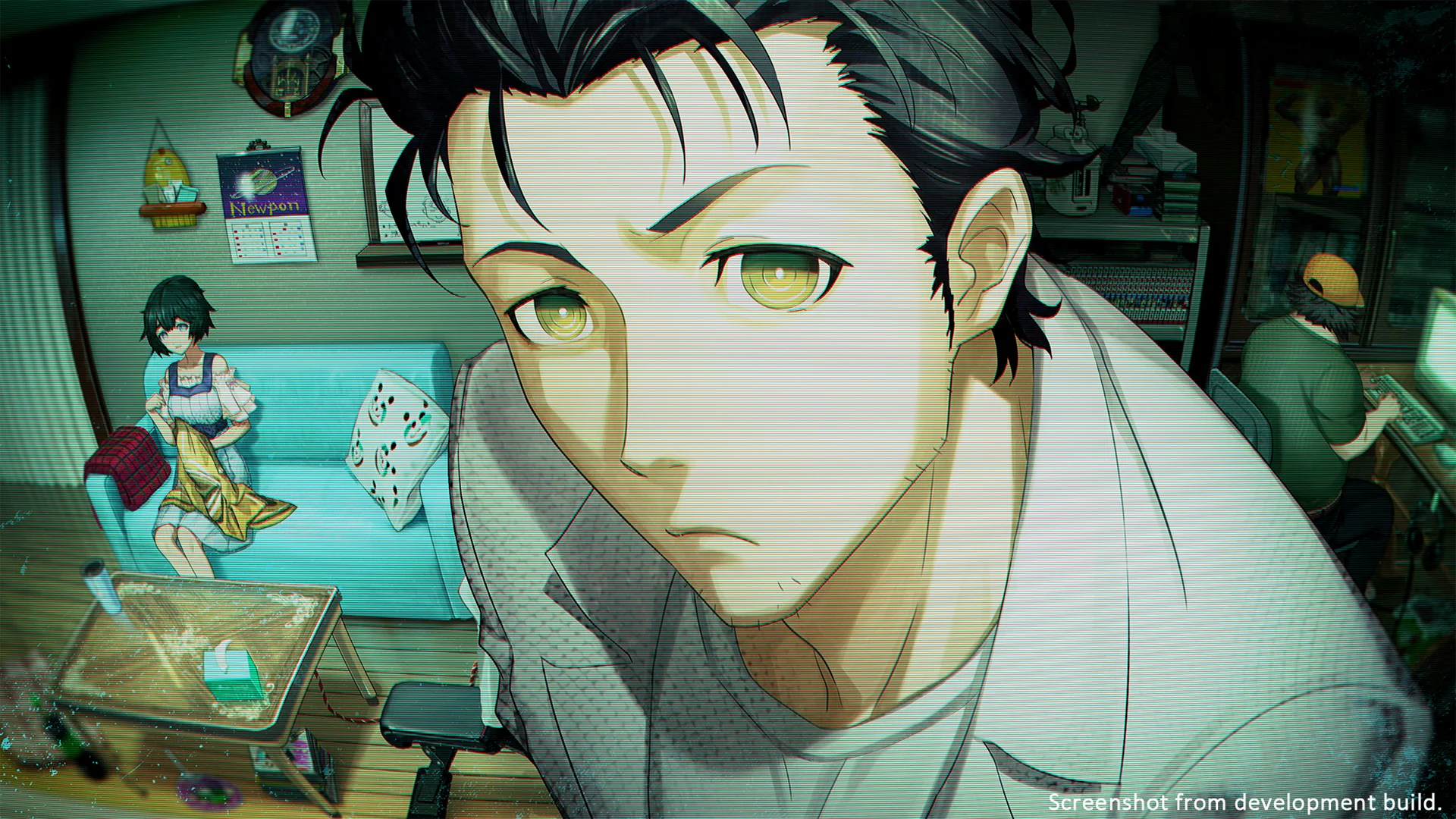
To summarise for the uninitiated, Steins;Gate Re:Boot tells the story of Rintaro Okabe, an eccentric student who spends most of his time in a small apartment in Akihabara, which houses the “Future Gadget Laboratory.” As his alter ego, the “insane mad scientist” Kyouma Hououin, Okabe designs scientific inventions which are principally cobbled together out of household items, to dubious effect.
Okabe is joined by his childhood friend, Mayuri Shiina, a carefree girl whose main purpose at the lab is to create cosplay outfits that nobody ever wears. Itaru Hashida, nicknamed Daru, an otaku with a particular interest in the more, ahem, specialist anime material available, provides the computer expertise and hacking proficiency. They are the first “Lab Mems,” but as time goes by, more characters join the fold.
At the start of the game, Okabe attends a conference on time-travel, which ends when he finds the blood-soaked body of Kurisu Makise, who has been murdered by an unknown assailant. He flees the scene and sends a text message to Daru, only to trigger a strange effect that changes the world around him. Shortly afterwards, he goes to another conference on the same subject, but this one is being given by Kurisu herself, who is alive and well. Kurisu is a scientific prodigy who outlines why the very idea of time-travel is ridiculous.
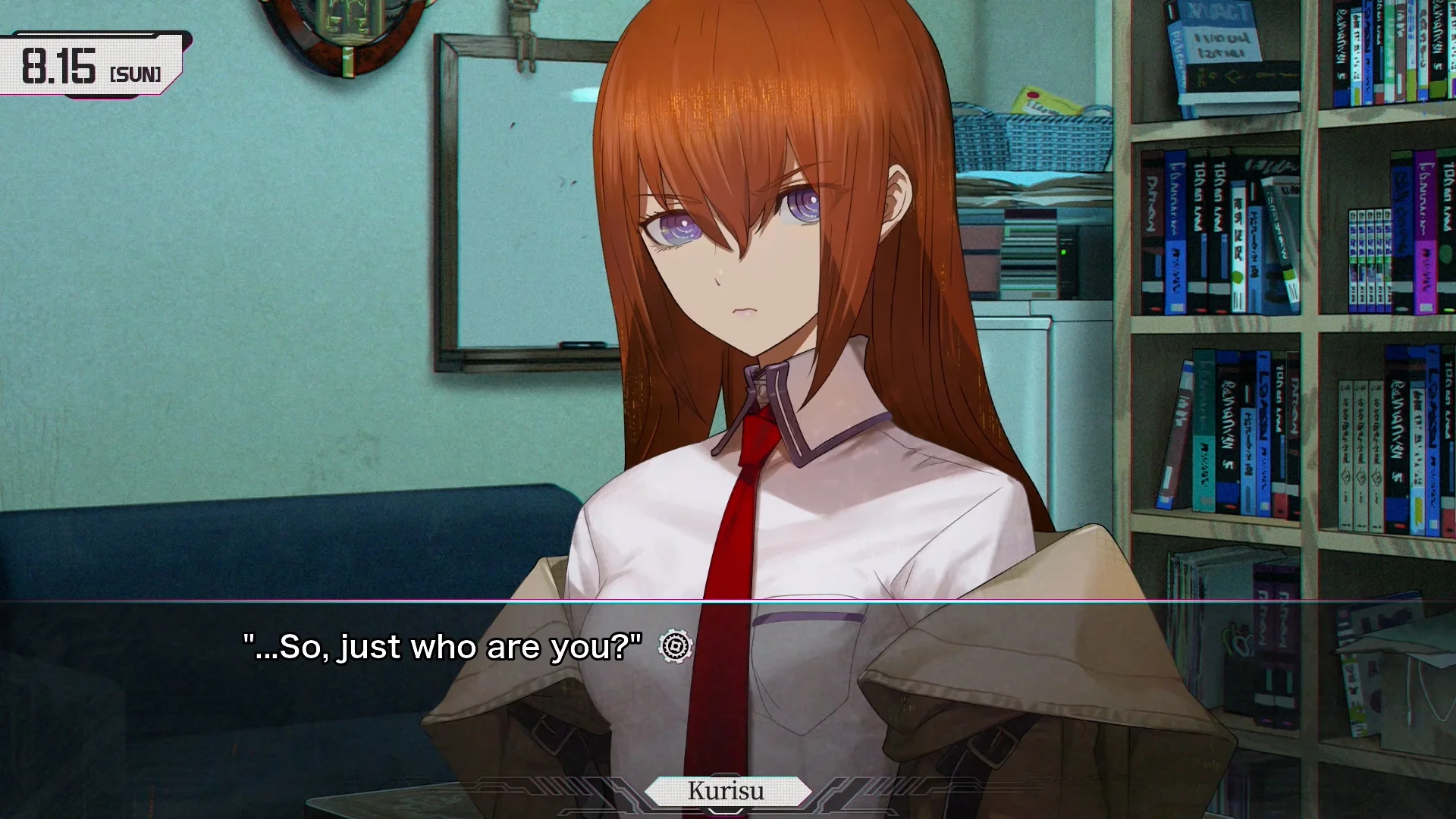
We soon discover that one of the Lab Mem’s inventions, the PhoneWave (name subject to change), has the ability to send data back through time. Not overly prone to caution, Okabe pushes forwards with various experiments, setting us up for an adventure through shifting timelines.
Barring the opening homicide, Steins;Gate Re:Boot has a light and comedic tone for much of its first half, driven by Okabe’s seemingly delusional nature, which is described as being “Chuunibyou,” a Japanese term meaning “eighth grader syndrome.” Okabe acts like a character from a Shonen anime, frequently boasting about his IQ of 170, and warning of a secret society, named “the Organization,” which is out to get him. None of his friends and acquaintances take this seriously, leading to multiple conversations and scenarios that are genuinely funny, something that is often aimed for in video game writing, but which is rarely achieved.
The second half of Steins;Gate Re:Boot takes an extremely dark turn, plunging you into a desperate situation that seems inescapable. The game manages this tonal shift perfectly, and it never feels forced, despite how easy it would be to clash with the earlier material.
In terms of how it plays, we are presented with the standard visual novel formula here, e.g., click a button to proceed. There is an option to autoplay and one to skip forward. You can set the speed of text and the volume of different elements, although I didn’t find these very sensitive, with text speed ranging from extremely fast to just about bearable, and vocal controls likewise being awkward. The autoplay function is welcome though.
There is some interactivity within the game, where you can choose to answer calls and text messages, and in some cases pick your reply. Steins;Gate Re:Boot has multiple endings, and these choices determine which one you receive.
It’s a fluid experience for the most part, but a little more effort in the execution would be welcome here, especially as this is a new iteration of Steins;Gate. You can choose to have the skip function stop playing for phone interactions, but this can be clumsy and interrupt the flow of the game, as it pauses for non-crucial moments as well as key decisions. On autoplay the text speed for phone messages is ridiculously fast, which meant that I needed to go back and manually check the phone after each message came in.
We are past time for an evolution of the skip feature. Here, while you can set it to skip through things you have experienced before, you still have to watch them, albeit at high speed. The ability to instantly skip between moments would improve the experience greatly, especially for replays.
The new graphics have proven somewhat controversial with the established fanbase, with criticism levelled at the new character designs by original designer, Huke. I looked back over the original art, and to an extent I can understand this. The graphics were different, earthier, more intense in some ways. To me though, the current designs are perfect for the story. Mayuri’s innocence and general good nature are epitomised in her open face and brighter, light-blue outfit. Daru’s lack of time for Okabe’s nonsense comes across in his new guise, which seems somewhat fiercer than before. Tech journalist Moeka Kiryu’s update is especially good, hinting more strongly through careful detail as to the role she plays in Steins;Gate Re:Boot.

Additionally, the E-mote system that Steins;Gate Re:Boot uses to animate its 2D characters revitalises the visual novel format, as you watch thoughts and feelings flicker across the characters’ faces, amplifying key moments in the game.
This wouldn’t be so effective without a cast who could adequately convey those emotions. Steins;Gate Re:Boot brings back the original Japanese voice actors, and it’s almost unbelievable that, so many years later, they can return to playing predominantly teenage characters with such success. It’s almost as if they have time-travelled themselves.
This has to be one of the best ensembles in a visual novel I have ever come across, making it difficult to single anyone out. I will say though that Mamoru Miyano as Okabe is central to this success, as he plays outrageous campness as well as he does pain and trauma, demonstrating an impressive range. Yu Koboyashi as male shrine maiden Luka Urushibara is also a highlight, with more demands being placed on his abilities in the later chapters.
With Luka in mind, I admire the complex examination within the game of this character, a female-presenting boy who wishes he was a girl. It’s not perfect by any means, and not being trans or queer, I can’t give a definitive take on this, but it is notable that Okabe treats Luka with affection and respect at all stages of Luka’s story. We’re never encouraged to ridicule or disdain Luka for being who he is, and Luka is one of the most pure-hearted characters in the drama.
The soundtrack has been remade, although it remains similar. But when you have a score as good as this, why change? Composer Takeshi Abo, who features on many of developer Mages’ titles, opens the game with the piano-driven song “Skyclad Observer,” underpinned by techno beats and the clean vocals of Kanako Ito. The song finishes with Ito sustaining a soulful note, driving you straight into the opening moments of the game, with Mayuri looking at you directly, a foreshadowing of things to come. Abo mixes the traditional with the electronic throughout, suiting the tone of Steins;Gate Re:Boot.
You’ll hear some of the tracks frequently, serving as punctuation to the narrative beats, signalling a mood, and tying to the themes of repetition and inevitability. These are explored in great detail, and Steins;Gate Re:Boot has no sympathy for those who want an easy ride. Detailed scientific theories underpinning the action take centre stage, although they are explained accessibly.
It’s a game that encourages you to think about the possibilities and paradoxes of time-travel, and the different ways in which it can be accomplished. As well as that, it asks you to explore the moral quandaries you are forced to make when you relive the past, and the effect of these decisions is on the individuals involved.
Steins;Gate is quite simply one of the most important visual novels ever made, and Steins;Gate Re:Boot is the perfect way to play it. Unlike games such as The Adventures of Elliot, each of its endings provides a uniquely satisfying conclusion to the tale, and you will want to seek each of them out before you finish. I suggest you fire up the PhoneWave (name subject to change) and send a message telling your past self to pick the game up. Then you will truly be living in the best timeline.