
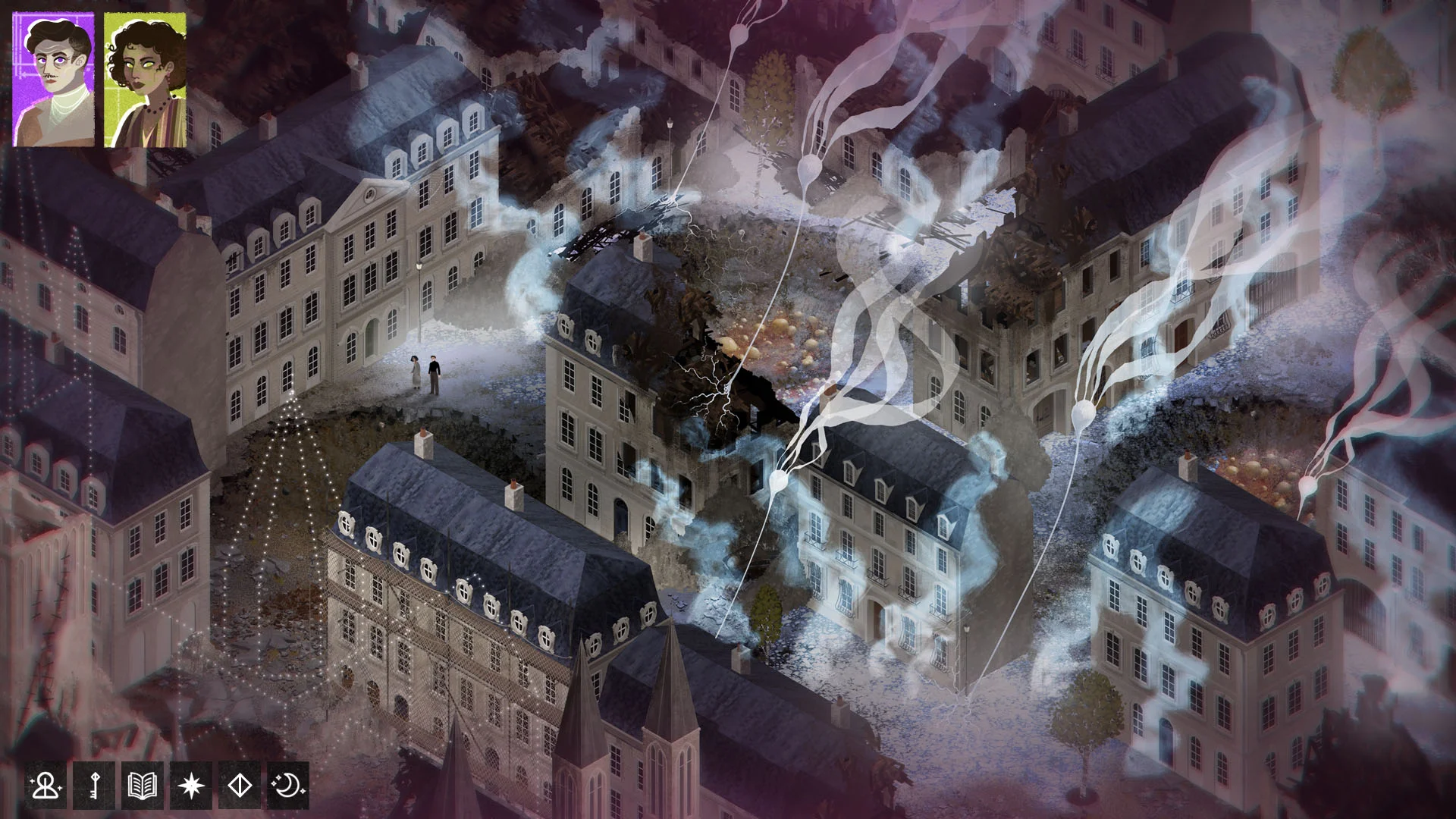
Travelling At Night exists in an era where the Disco-like is becoming pervasive. Heck, I’ve commented upon as much myself, and my fellow colleagues at RPGFan have enjoyed their fair share, many featuring a metaphysical (and often literal) thread back to the glum, glorious shores of Revachol. Recently I spent time with the beta demo of Travelling At Night, the latest game from the Cultist Simulator devs, Weather Factory. There are all the hallmarks of a startlingly original story here, with a commitment to internalising character, as well as a distinct world and art design that demands notice. So, won’t you join me on this midnight journey?
Set in a twisted reflection of 1948 Europe, Travelling At Night plunges players into a world shattered by the recent Great War and suffocated by cosmic horror. Void-scarred buildings and night-sky abysses form the backdrop of a tense Cold War between the golden Incorporates of the USA and the star-touched Ministries of the USSR, where dark gods and occult forces physically and psychologically corrupt reality. Twelve years after the Worms from under the world hollowed out his memories during a bitter Cracow winter, former esoteric operative Spencer steps into the southern French city of Antibes. A narrative blank slate driven by a single, burning compulsion, Spencer seeks a mysterious woman named Nina Lagasse—the sole thread tying him to a long, relentless past that refuses to stay buried.
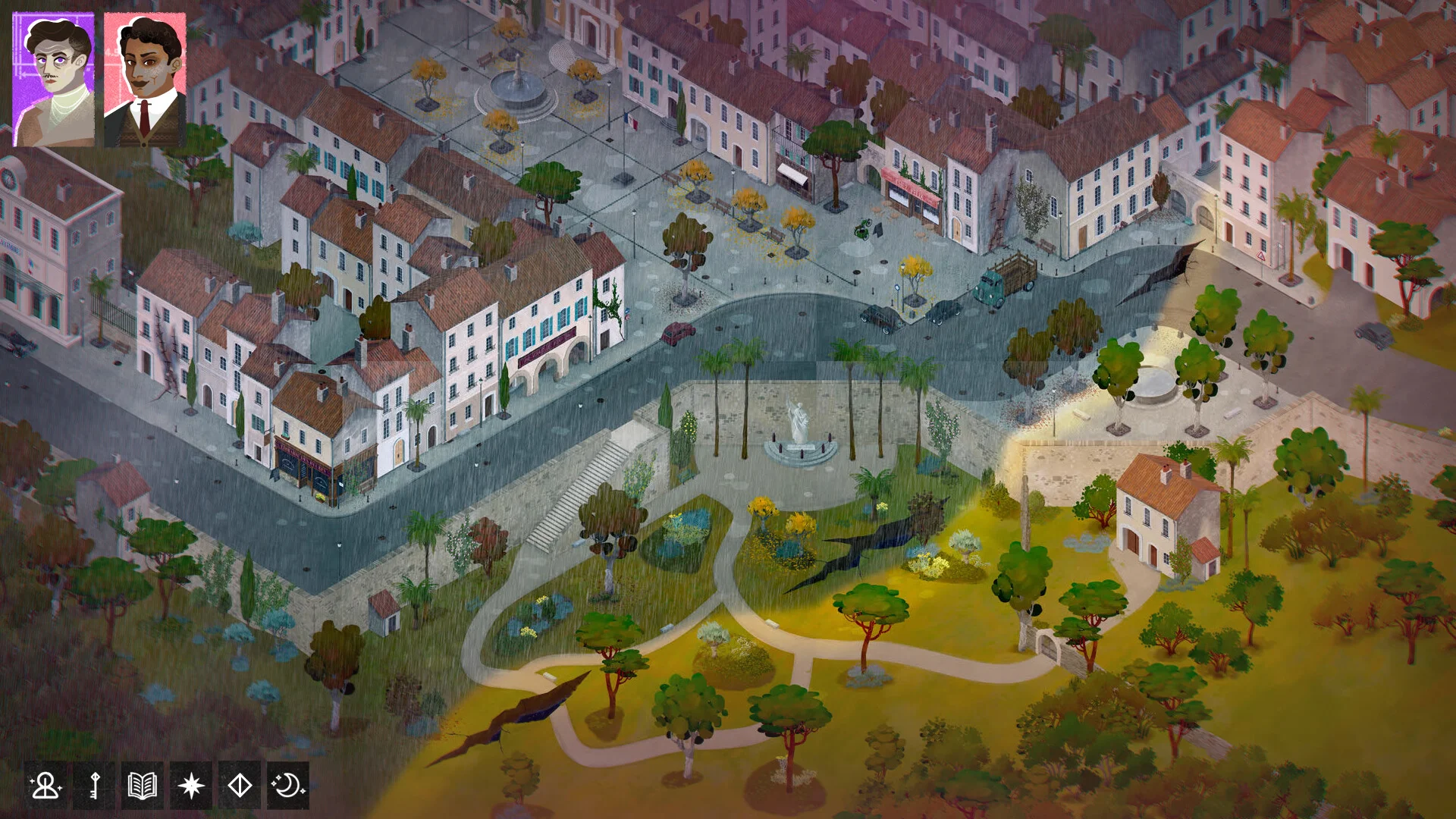
Jagged tears in reality rip through the sleepy streets of Antibes, exposing cosmic starmaps that gaze back from the immense void, while stitched-up buildings bear the scars of crude structural triage. Travelling At Night leverages a bold art aesthetic—plenty of odd mashups of realist structures with startlingly unreal appearances—to instantly thrust its surreal horrors into focus. By stripping away extraneous texture, the visuals force you face-to-face with unnerving anomalies, from gaping tears in space-time to a giant grasshopper wrapped around a sanatorium guest, crafting a deeply unsettling atmosphere. It all looks great and suggests the developer’s early intentions were borne out: “about as far in the non-realistic direction you can go and still be plausibly CRPG.” The music so far builds on this oppressive atmosphere while remaining minimalist. The light jazz music issuing from a local cafeteria is in stark contrast to the insistent, droning menace while wandering around Antibes or the slow strings and stately brass chords of the sanatorium.
Travelling At Night plunges players into a rich, dense tapestry of cosmic passions, secretive organizations, and occult lore, revealing its world organically through handy nested tooltips. While the sheer volume of worldbuilding threatens to overwhelm at first, the gradual discovery mirrors Spencer’s own muddled, healing mind—a man who possesses deep knowledge of his reality, yet struggles to connect the dots. Despite fitting the classic broken-amnesiac archetype, Spencer operates with decent agency and grit, wielding a full suite of tools to make sense of his shattered reality. Developer Weather Systems has populated his journey so far with vibrant, well-written characters—from an acerbic dame bent on vengeance to an obsequious sanatorium director—bringing Antibes to life through razor-sharp dialogue and stylish, non-sequitur observations. Though currently unvoiced, the script’s sharp literary style leaves immense potential for the promised voice acting.
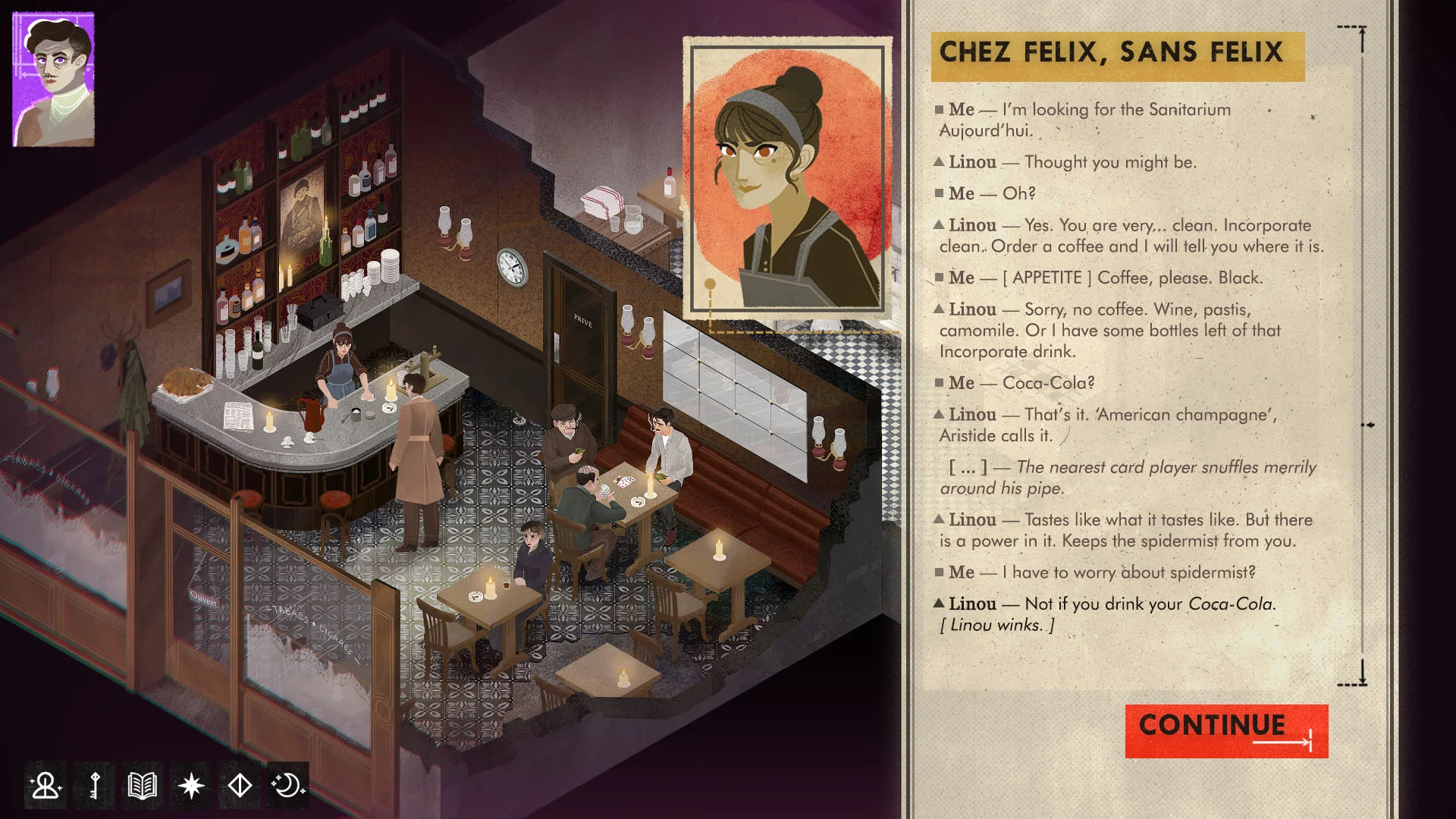
Unsurprisingly, the game’s formidable lore shares deep roots with Cultist Simulator and the Secret Histories universe, and veterans of Hush House have a more familiar entry point, while newcomers immerse themselves in tooltips and careful record-keeping. Alongside these traditional methods, the game introduces an inventive “Footnotes” system, allowing you to expand on Spencer’s activated memories and choose responses to deepen his understanding of past experiences. I found it a novel means to provide lore-dumps with more agency on the player’s part. By the demo’s end, Travelling At Night burdened me with many more questions than answers—but with an urge to uncover the truth, even while hinting that some cosmic mysteries might be better left in the dark.
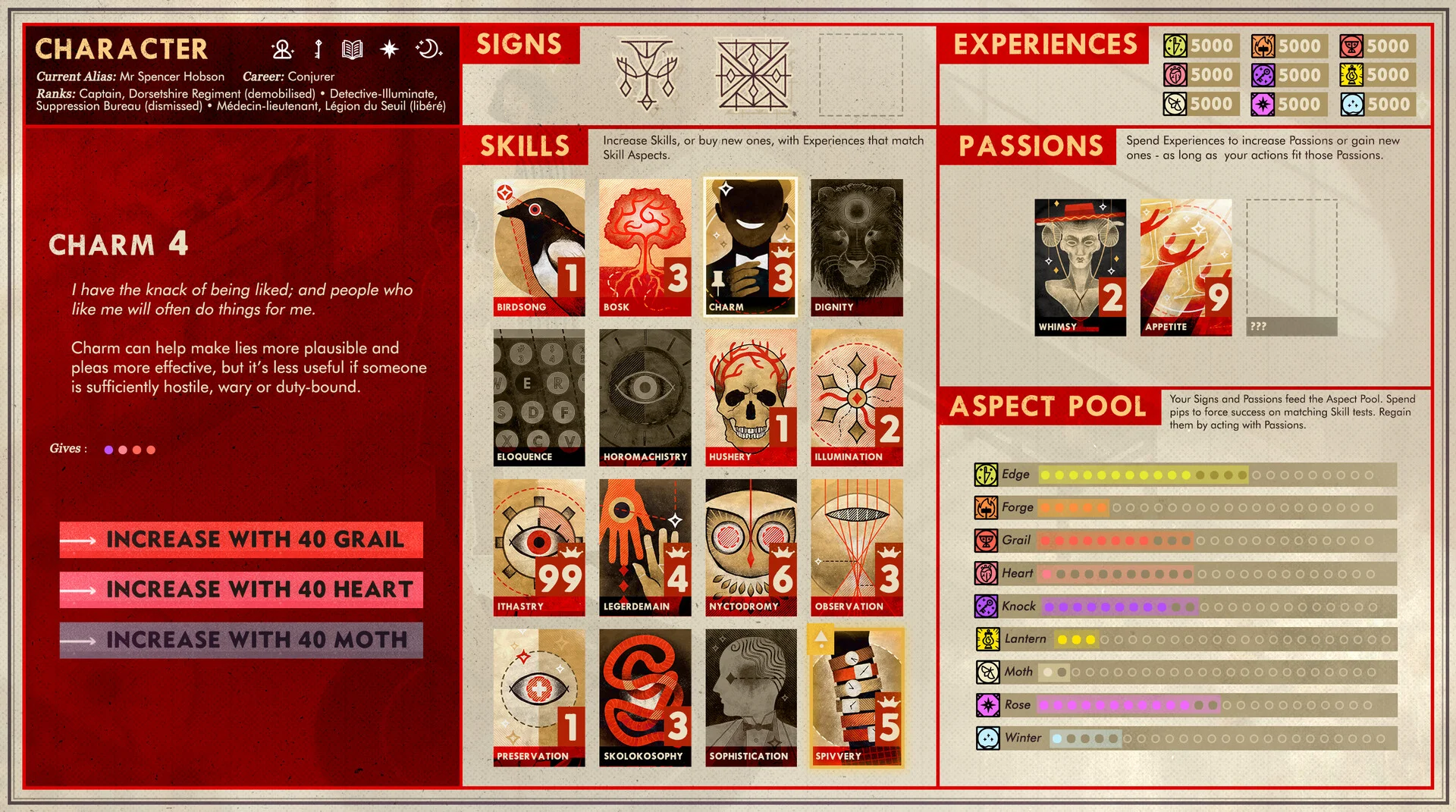
Spencer’s core identity stems from four distinct career choices—Exorcist, Writer, Conjurer, or Physician—each tying his esoteric past to specific Passions and Aspects that directly govern his skills. While familiar skills like Charm and Dignity exist in Travelling At Night, most skills tap into unseen cosmic forces like Bosk or Nyctodromy. Skill checks generate a difficulty threshold for RNG rolls based on environmental factors, character attitudes, and Spencer’s accrued points. It’s possible to sacrifice skill experience for short-term roll bonuses, and as a result, Spencer’s worldview is continually being shaped by his decisions, large and small. My Spencer managed to keep the honourable, compassionate side of his medical career throughout the demo, but towards the end my/his choices reflected more cynicism. Spencer doesn’t remain on his own either: there’s the opportunity to add another character to the group who can aid skill rolls as well as, presumably, add extra narrative options.
Beyond basic skills, dynamic conditions like Dread and Trace can also affect gameplay. Dread tracks Spencer’s creeping existential doom, raising skill check difficulties as it crosses key thresholds, while Trace measures how easily authorities track his movements—potentially leading to being actively hunted. During the demo, I progressed all the way to ‘Pursued’ thanks to my unscrupulous desire to introduce Spencer to everyone and his mum, although I didn’t see a game effect.
Ultimately, this interconnected web of Passions, Aspects, and escalating risks builds a system that appears far more complex and interconnected than Disco Elysium and practically begs for multiple playthroughs to master its intricate mechanics.
Along with his skill development and experiences, Spencer can craft items to support him in his journey. There were several available in the demo, and they require the relevant skills, relevant base items, and the right location to craft them. The church in Antibes functions as a craft base for items with a holy aspect, for example, and I can see how managing the three interwoven requirements could lead to lots of different approaches and outcomes, assuming they’re discovered. There are regular vendors who sell items to support the narrative who use several European currencies, depending on their preference, with different vendors favouring one or the other.
Aside from minor textual errors and work-in-progress quest logs, I experienced a smooth run with Travelling At Night, free of glitches or softlocks. A few minor foibles still need polish—such as clearer skill identification during experience hoarding and less click-heavy map pathfinding, even with Spencer’s run toggled.
Travelling At Night demands far more from you than typical narrative RPGs. Tracking skill use, managing intricate crafting mechanics, and interpreting complex outcomes will surely require time and multiple playthroughs to truly master. The systems are well-developed and look to hold plenty of depth and variation. Systems for item crafting and outfits mean that those who like to play with the numbers will not be disappointed. Travelling At Night is a dark, immersive world with a deep, murky hold on me, and I can’t wait to be part of the full journey. All aboard.


Leave a Reply
You must be logged in to post a comment.