
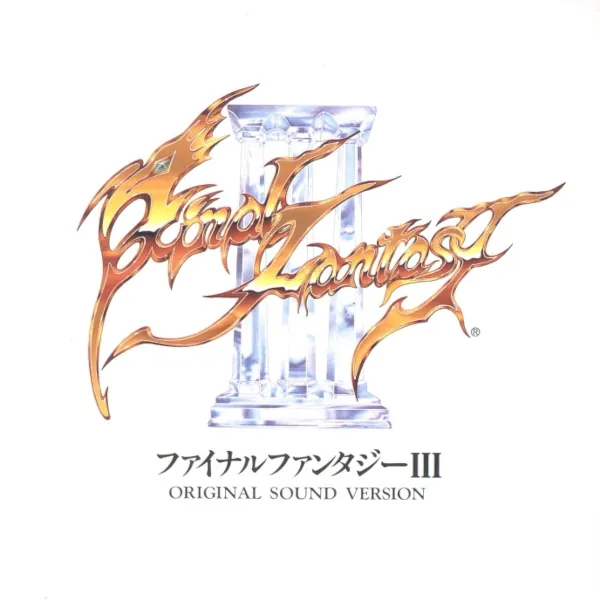


In summer 2000, at the young age of 16, I wrote an embarrassingly terse review of the Final Fantasy III soundtrack. Granted, everything about this entry in the acclaimed series seemed novel at the time, given its lack of official localization (until the DS version release in 2006). But there was, and is, so much more to say about this soundtrack than “you need to hear it for yourself, it’s pretty good!”
So here I am, 25 years later, giving Uematsu’s score to Final Fantasy III the in-depth analysis it rightly deserves.
In terms of sheer quantity, Final Fantasy III stepped up in a big way. If you compare this soundtrack to All Sounds of Final Fantasy I • II, you’ll notice that III (44 tracks) has about the same amount of music as I & II combined. And when Nobuo Uematsu jumped into the world of the Super Famicom, he also created the Final Fantasy IV soundtrack with exactly 44 songs, and a similar runtime to this soundtrack. All this to say, for its time, the soundtrack to Final Fantasy III was big.
As we all know, however, quantity and quality have no intrinsic correlation. Even among the Square Enix music catalog alone, there are short and long soundtracks that are amazing, and short and long soundtracks that falter. And while we would consider a one-hour OST short in 2025, this was an extensive soundtrack for its time. Was it a quality soundtrack then? And what would we say now?
Given Final Fantasy III was Uematsu’s last soundtrack for 8-bit, hardware-generated audio (aka chiptunes), whether for Famicom (NES) or Game Boy, he had plenty of experience to help him craft something special before graduating to the next generation of hardware with its sound banks and synthesizers. Therefore, Uematsu went all out with his three audio channels, though I think it’s safe to say that some songs got more care and attention than others.
One of the biggest stand-outs is “Crystal Cave,” the second track on this album. Anyone who has played Final Fantasy III knows how this goes: standard prelude and text, name your four generic characters (the onion knights), and then the characters fall through a hole and have to escape a cave. This dungeon theme is remarkably well-crafted. There’s an arpeggiated line for the mid channel that builds from a minor chord, to an inverted major (fifth raised to minor sixth), then that note is raised again to a major sixth, then back down.
This chord progression has since become a staple for Nobuo Uematsu and the Final Fantasy series (see FFVIII “Fithos Lusec” / “Succession of Witches” theme). In this early instance of the chord progression, Uematsu builds a melody atop it that starts by running in thirds against the arpeggiation, then rolling sustained octaves in the diatonic minor scale. The bass line is pretty simple here, but everything else is super catchy, and arguably a step above the dungeon themes of previous Uematsu soundtracks (FFI, FFII, and The Final Fantasy Legend / SaGa for Game Boy).
Much as I love this dungeon theme, I think the forever-favorite among fans has to be Final Fantasy III‘s world map music, “Eternal Wind.” You want to hear the NES sound chip soar to new heights? This is the song for you. In terms of composition, this is a simple piece of music, stepping through a typical chord progression. But, again, it’s that middle channel, the busy counter-melody, that brings so much life to the music. The bass is bouncy and the melody is memorable—but the middle with its syncopation, reverb, and attention to detail, makes the piece wonderful.
When this particular piece has been arranged or remade, its success or failure falls squarely on whether they choose to include the middle counter-melody or cut it because it’s too busy or distracting. In my opinion, you cut this line at your own peril. It defines this piece of music.
A little past the halfway mark, Uematsu serves up a one-two punch of emotional, watery goodness. “The Boundless Ocean” and “Elia, the Maiden of Water” are melodically rich, with harmonic structure benefiting from the subtlety and vagueness of modern chord extensions (7th and 9th, primarily).
If you’ve played Final Fantasy III and can remember the context for these pieces of music—discovering the world you’ve known is a tiny flying island over a world frozen in time and covered in ocean, and a sole maiden in a shrine awaits your arrival to bring this world back to life—it suggests to me that director Hironobu Sakaguchi and his team impressed upon Uematsu the importance of making these moments memorable. And, well… mission accomplished.
Another personal favorite for me is the brisk 6/8 piece “Let Me Know the Truth,” which serves as the area theme for Doga and Unei’s mansion. The repeating notes at the beginning, fading in volume to suggest a ringing echo, sound so impressive for the limitations of the hardware. And then that fast, meandering melody? It is a joy to listen to, and speaking as a hobbyist pianist, it is also fun to play on repeat!
Final Fantasy III‘s last set of dungeon themes, like the dungeons themselves, are forces to be reckoned with. “Forbidden Land Eureka,” “The Crystal Tower,” and “The Dark Crystals” crank up the intensity to 11. The neo-baroque counterpoint on “Forbidden Land Eureka” is so epic, it would sound equally awesome voiced with a pipe organ as with an electric guitar. “The Crystal Tower” and “The Dark Crystals” have a similarly epic, almost sacred presence on the album.
For you battle music fans, I have good news and bad news. Starting with the bad news: there are only three battle themes. “Battle 1” is your random encounter music. “Battle 2” is for boss fights. And of course, “This is the Last Battle” is exactly what it says on the box. The good news is that these three tracks are all solid. The standard battle music has the memorable bass intro, and it experiments with the effects channel to try and throw in some drums. I also think, and this may be controversial, that melodically the “Battle 1” of Final Fantasy III is more catchy and interesting than its I and II predecessors.
“Battle 2” has some strong melodic ideas as well, particularly in the B section when it plays off of the IV chord to maintain a major sound. This, alongside the fun percussion, almost makes for a kind of Mega Man stage theme. “This is the Last Battle” starts with a lengthy, slow-creeping intro that hits double time before finally breaking into a killer rock anthem. Both the melody and the counter-melody are intense and furious here. This particular track makes me wonder how Uematsu would have crafted the final battles for IV, V, and VI had he still been limited to the NES sound chip.
Having discussed some of my favorite themes, I must give the disclaimer that not all of the songs here are amazing. Or, perhaps it’s better to say, not all of these songs sounded amazing given the limitations. However, I still think the many melodies that make up the Final Fantasy III soundtrack are among Nobuo Uematsu’s best. My evidence? Subsequent arrangements.
For example, “Cute Little Tozas,” the music for the gnome village where you have to cast Mini on yourself just to enter. The song is fittingly cute, but perhaps overly so. It is saccharine, and in the context of the 8-bit original, it doesn’t really go anywhere. Arguably, the 2006 DS remake of Final Fantasy III and the recent Pixel Remaster don’t do it any favors either.
But have you heard its vocal arrangement, “Have You Ever Seen Me?” on the FF vocal collection album Love Will Grow? Give the folks of Tozas some bluegrass fiddles and a star vocalist, and apparently, they can make something beautiful. For decades, whenever I hear this tune in its original form, I can’t help but jump in and sing: “…in the forest you can have a lot of FUN!” Apparently, Uematsu was writing a show tune all along; he just hadn’t realized it yet.
Still not convinced? Compare the original NES version of “Castle of Hain” to its Pixel Remaster counterpart. On three audio channels, this piece feels plodding, uninspired, and even boring! However, take the three audio channels and divide them into appropriate chamber music instruments (woodwinds, strings, harpsichord), and suddenly it’s a strong dungeon theme. The melody sticks with me better thanks to this remade version!
So, yes, that’s my take. Final Fantasy III has a strong, often underrated soundtrack. There are some clear favorites, but even the weaker tracks hold the potential for greatness, held back only by the limitations of the era. For those of you searching for a physical copy of this album, NTT printed it thrice in the ’90s, and it’s not terribly difficult to pick up secondhand via online services like Yahoo! Japan or Mercari. Digital distribution through Apple Music / iTunes, Spotify, etc are also available in multiple regions.