
Nintendo’s Paper Mario series (The Thousand-Year Door, in particular) has left quite an impression on the RPG world. In recent years, we’ve seen many Paper Mario-inspired RPGs such as Born of Bread, The Outbound Ghost, Bug Fables: The Everlasting Sapling, and more. The latest Paper Mario-like to come my way is Escape from Ever After. Its wacky characters, goofy premise, and boppin’ soundtrack ooze with charm, but flawed gameplay holds it back.
Escape from Ever After stars Flynt, a typical storybook boy hero whose arch nemesis is a tyrannical dragon named Tinder. One fine day, Flynt enters Tinder’s castle only to find that Tinder’s been evicted by an otherworldly corporation called Ever After Inc. To add insult to injury, Ever After Inc. turned Tinder’s castle into a cubicle-filled office building staffed by a variety of other storybook characters.
A confused Flynt then meets Mr. Moon, the branch manager whose previous life was in a children’s book. Flynt refuses Mr. Moon’s offer to enter corporate servitude and is thrown in the dungeon. Flynt comes to, only to find that his cellmate is Tinder… albeit rendered physically smaller and weakened by one of Ever After’s impossible-to-remove neutralizing collars. Not willing to take this corporate takeover of their storybook lying down, Flynt and Tinder reluctantly team up to bring down Ever After Inc. from the inside.
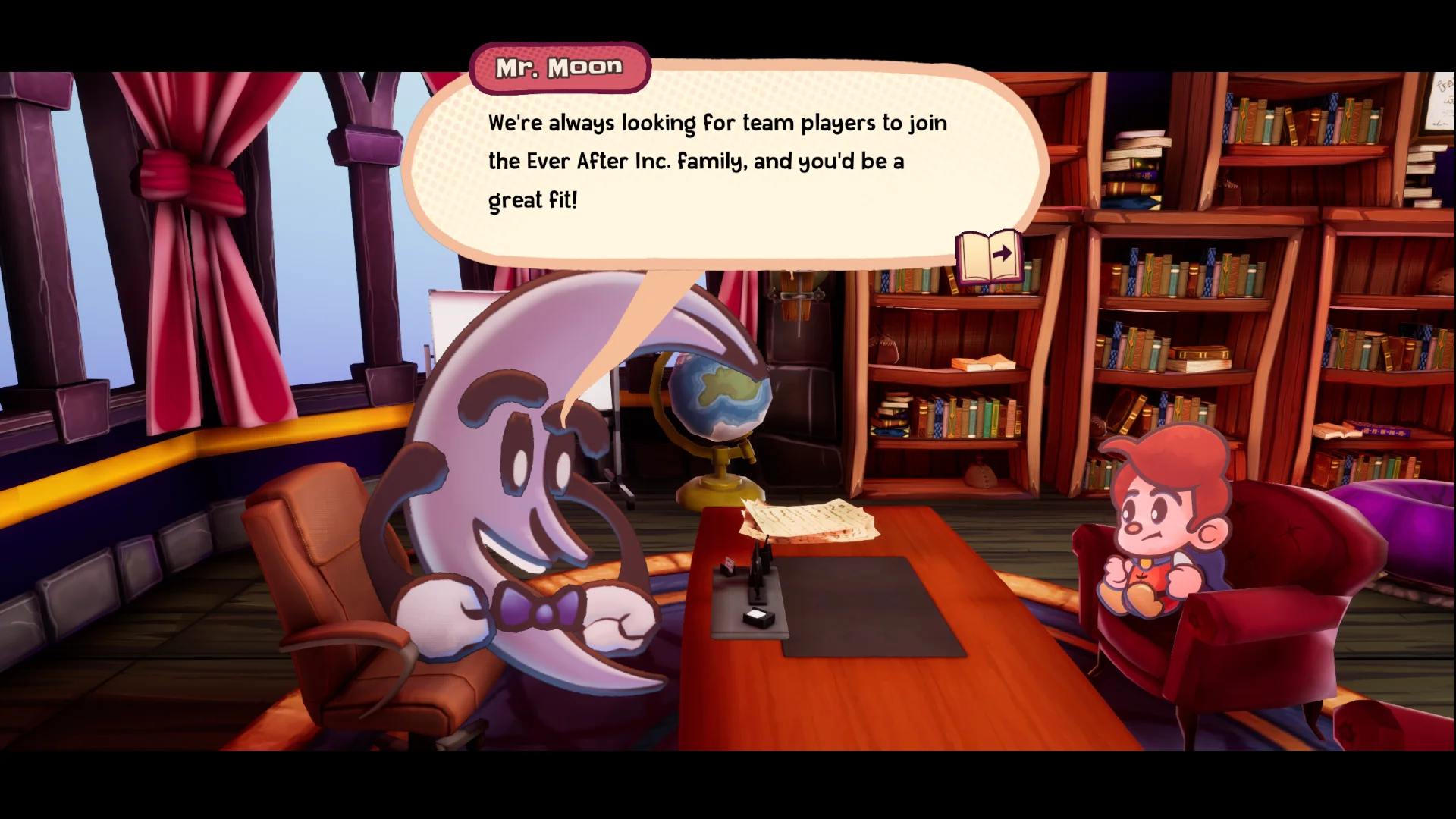
As expected, the task is not as straightforward as it first appears. Flynt’s journey takes him in unexpected directions as he meets a cavalcade of colorful characters along the way. Flynt is a generic hero by design, but Escape from Ever After’s real heart lies in Flynt’s playable companions and its myriad NPCs. My favorite playable character is the Big Bad Wolf, who’s really the Big Bard Wolf. My favorite NPC is Helga, a seafaring Viking adventurer brainwashed by Ever After Inc. into believing that her new life striving to climb the corporate ladder is true freedom. Corporate tyranny is the insidious enemy Flynt, Tinder, and company aim to eradicate.
Escape from Ever After’s premise is nonsensical and absurd, yet charming and amusing due to the clever writing and fun characters. Many aspects of the plot and worldbuilding don’t make logical sense, but so what? Most fairy tales don’t make sense either, yet we enjoy them nonetheless. The same principle applies to Escape from Ever After. Don’t look for logical sensibilities; go along on the 17ish-hour ride from its goofy beginning to its wild endgame.
Jazz-inspired music elevates Escape from Ever After’s atmosphere. I particularly enjoyed the jaunty music that plays in Tinder’s castle/the office building that Flynt and company use as their home base. It evokes the vibe of elevated elevator music combined with the smarmy happiness exuded by “that” kind of manager. The music in the other storybook worlds Flynt explores matches the environments exceedingly well, being simultaneously atmospheric and fun. However, the battle and boss themes are lacking. They are well composed, but not punchy enough to be rousing combat compositions.
The places Flynt and company explore are fairly linear to navigate, so exploration is not too expansive. Save points are plentiful, so I did not miss the lack of an auto-save. Journeying mainly consists of puzzle solving, platforming, and various combinations thereof. In the field, Flynt and his companions each have field skills they use to solve puzzles and access new places. If you dislike “puzzle dungeon” type RPGs, Escape from Ever After is not for you. Not only are there tons of puzzles, but some are quite frustrating (the library puzzle in chapter four is particularly insidious). Even some easier ones take time to solve, putting the brakes on forward momentum.
Puzzle sequences requiring timing and dexterity were a struggle due to the rather sensitive control inputs. Simply running around felt like sliding on a slushy or icy sidewalk. Loose and floaty jumping made platforming frustrating; I fell into the drink more times than I can count. At least I didn’t lose HP when I fell in. Escape from Ever After’s 2D sprites in 3D (or 2.5D) polygon environments evoke that storybook/diorama look, but when moving Flynt’s sprite toward me, there is no invisible fence to prevent me from falling off an unseen drop.
Along with an input sensitivity adjustment, Escape from Ever After also needs an option to remap controls. I often pressed buttons I did not intend to press. This was especially maddening during puzzles that required precise timing to switch characters, engage their field skills quickly, and platform jump all within limited windows.
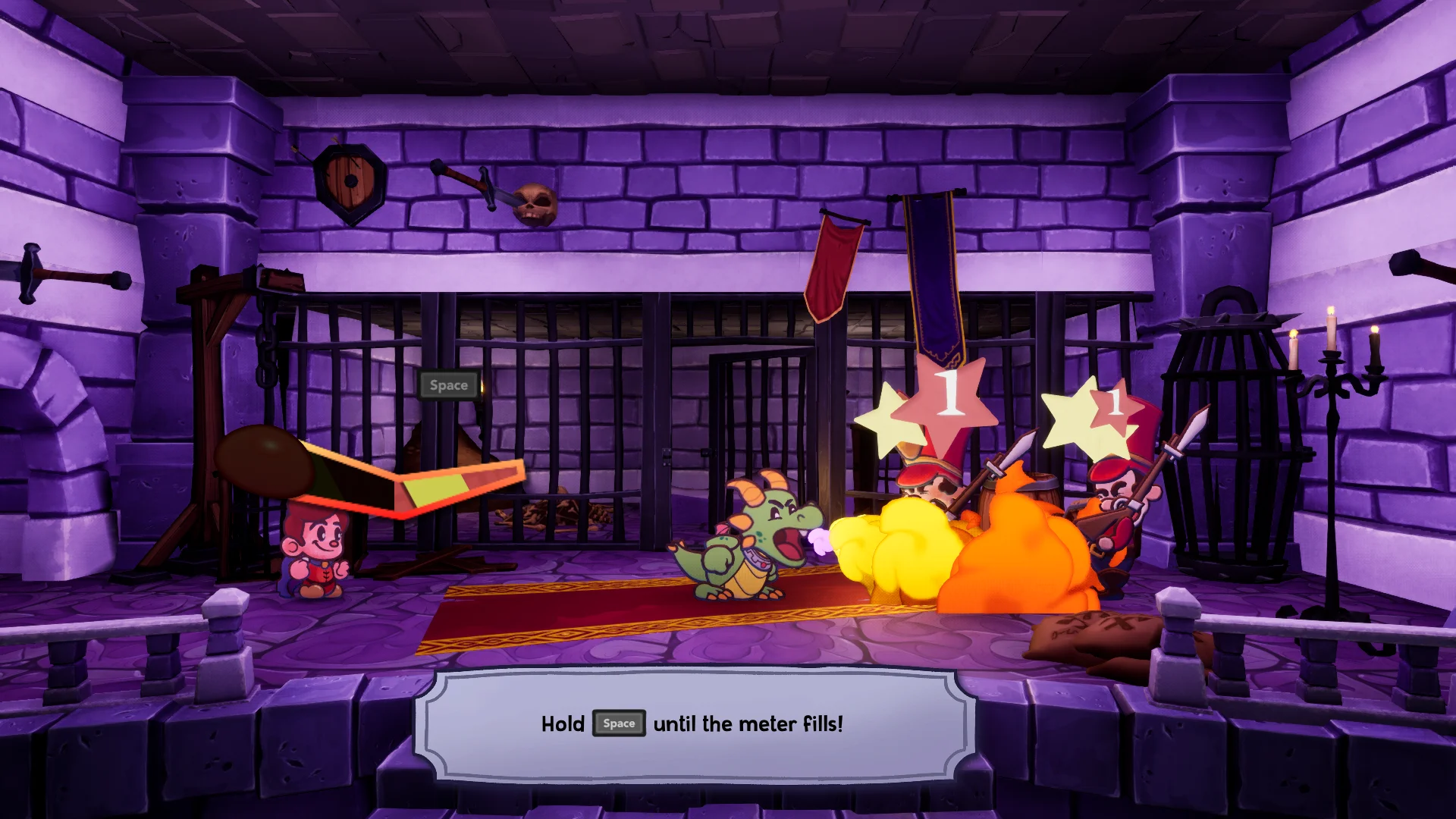
Battle employs some of these same precise timed inputs with standard moves, defensive blocks, and minigame-style sequences for special moves. Encounters are turn-based, and only two can fight at once. Knowing when to swap characters to utilize their skills is strategically important. All characters gain full EXP after battle, so there is no penalty for swapping out. In fact, many battles encourage frequent swapping. Unfortunately, button press timing for these actions is incredibly finicky. Missing means either dealing paltry damage or taking excess.
Escape from Ever After offers attack-assist and guard-assist options to automatically do the timed button-press actions. Using these options made the game more playable, but I should not have to switch off a game’s core mechanic to make it more enjoyable. Escape from Ever After also offers three difficulty levels to choose from (easy, normal, and hard). That said, there are some sudden and sharp difficulty spikes throughout that exist even in easy mode with the assists turned on. Some boss battles felt cheap and/or relied heavily on luck to win (chapter two’s second battle with Duxter in the catacombs comes to mind). Other battles, both boss and regular, were battles of attrition due to several nuisance mechanics (e.g., enemies with shields that need to be neutralized in order to deal damage) and some foes being HP sponges.
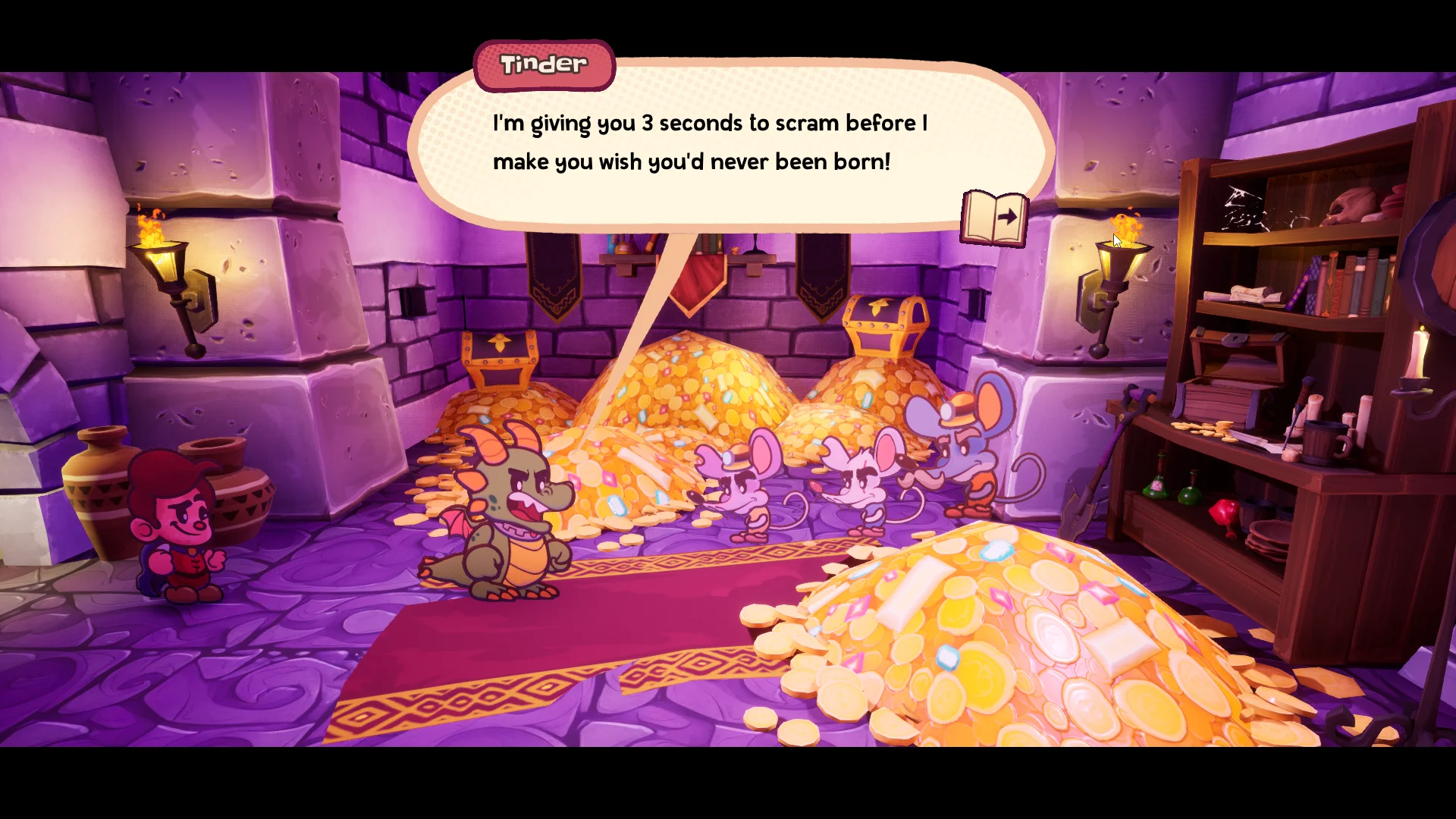
Escape from Ever After is a nice-looking game. The cartoony 2D sprites have clean lines and are quite expressive. They fit nicely into the whimsical 2.5D and 3D polygon environments for that storybook/diorama look evocative of the Paper Mario series. Because the playable and non-playable characters all come from various storybooks, Escape from Ever After is filled with a plethora of fun and creatively designed characters. For example, seeing a big ol’ minotaur sharing office space with a dainty little pixie amused me. My only graphical caveat is that while menus are visually stylish, they’re cumbersome to navigate.
My stance on Escape from Ever After is clear. The characters, music, and writing are tons of fun and exude plenty of charm. Unfortunately, the gameplay, especially the mushy controls, sharp difficulty spikes, and maddening puzzles, left me feeling cold. So, despite its potential, Escape from Ever After was a middle-of-the-road Paper Mario-style experience for me.