
Gather your mercenaries, manage their loadout, and watch your group finances: Veterum follows as much in the wake of fantasy mercenary company RPGs as many others, including its own direct precursor. On leaving early access, the unit trait and movement-based strategy systems and a varied world of random events and scenarios do much to keep the mission afloat, even if the core narrative and visual design (as well as a few control foibles) make truly inhabiting the world difficult. Veterum pays well and pays on time, but it’s not a best-in-class employer.
Crasleen Games’ Veterum drops players into a dark fantasy realm teetering on the brink of apocalypse, where ancient wild forces have reawakened and dark cults run rampant. As a commander of the Order of the Gatekeepers—the world’s last line of defense against encroaching chaos—you are charged with venturing across a non-linear open map to rally fragile alliances between distrustful factions like Humans, Dwarves, Elves, and orc-like Turans. Rather than relying on a strictly scripted narrative, the game weaves its story dynamically through procedural world events, weaving in emergent faction tensions and internal mercenary friction as Edward (the commander) scrambles to gather helpful artifacts and halt the end of days. There’s a lot of text to get through to understand Veterum’s world lore, but with no other artwork or visual design elements to sell it, the walls of text struggle to land the core story or side vignettes well, and the small, tight font doesn’t help matters.
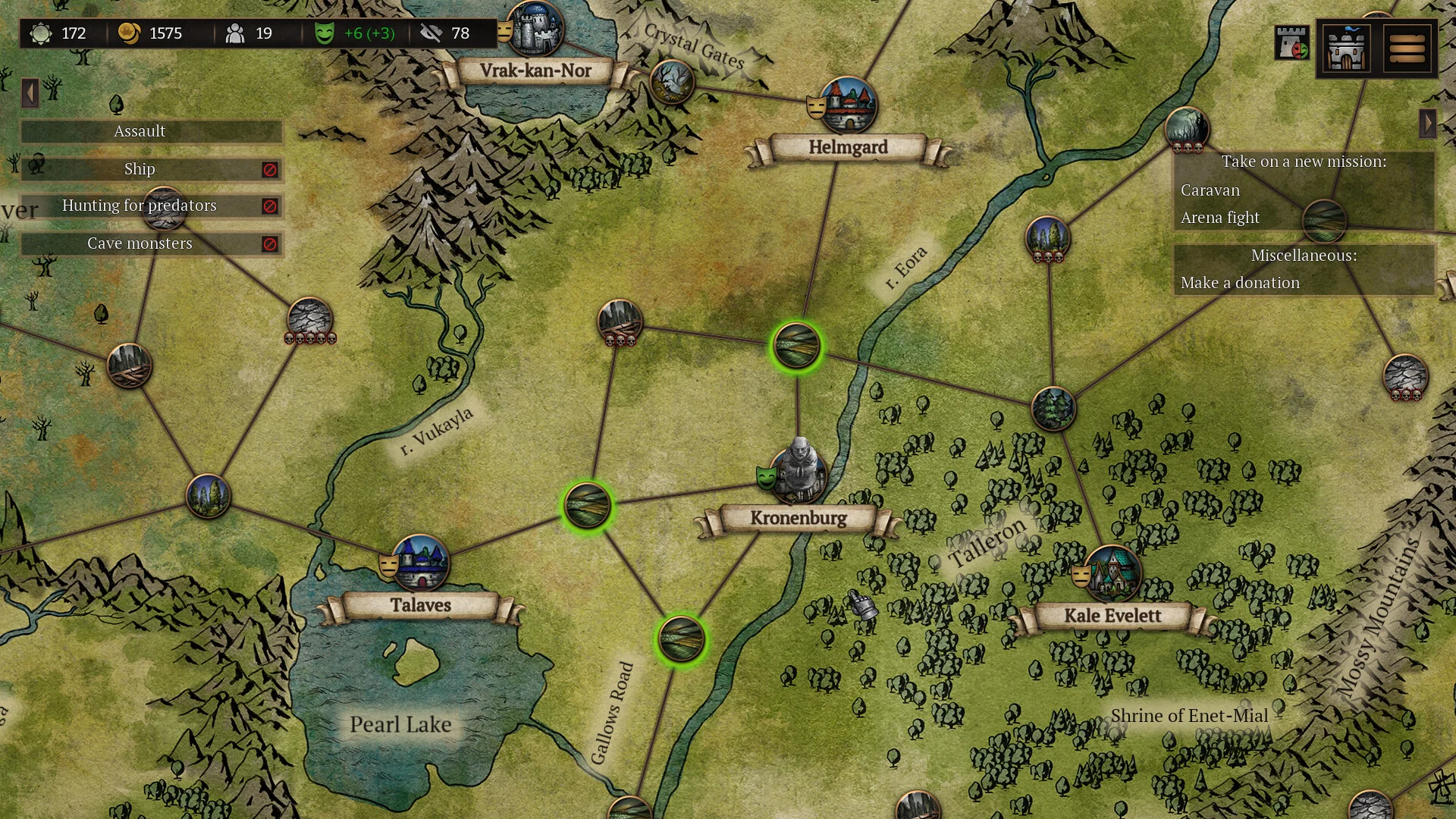
Edward leads his company around a static world map, visiting city or location nodes and selecting the missions that appear or events that trigger. These are somewhat randomised for every playthrough, and there is extra dynamism in how settlements can become ravaged by enemy actions or their relationship drops with you to such a point Edward is denied entry or access to services.
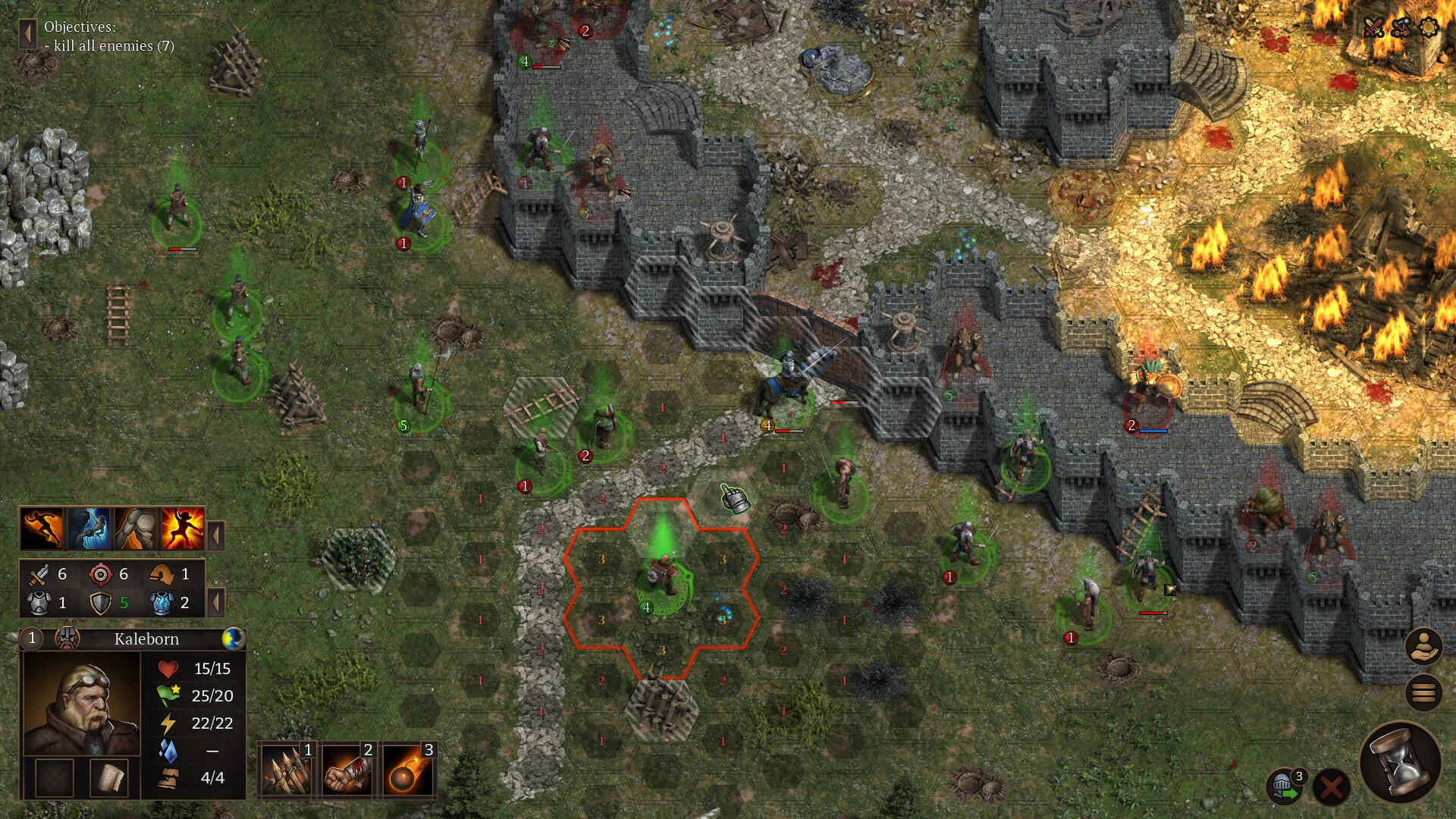
From an art design perspective, Veterum is all about the tactical map battles. The overland map is basic and perfunctory. City tokens and terrain indicators are simple and rooted in pastoral fantasy: there are no Volcano Ruins or Floating Tundra caverns to see here. Tactical maps fare better, with terrain elements, such as impassable terrain, fire, or water, visible and detailed enough to plan around. Character tokens do suffer from generic design, and what’s worse, they can’t be customised in any way, nor are enemy tokens varied.
They’re quite small, given the size of the armies, and even the nicer designs (such as the undead forces and the dwarves) don’t have the chance to ping off the map. Similarly, animations, like damage and spell effects, are low-key. The odd explosion and a few floating status effect markers are the stock and trade. In fairness, the whole setup is comparable to other mercenary RPG games. Still, it feels like a little more pizazz would benefit these elements, especially because tactical maps are the majority of the game. Battle Brothers is a good example: not particularly complex art design or effects, but a very definite sense of character and pawn design. I worry Veterum appears (and is) too generic for some folk who value visuals just as much as tactics. Music and sound effects are similar: the score feels bland, and the simple sound effects for abilities and damage are very old-school.
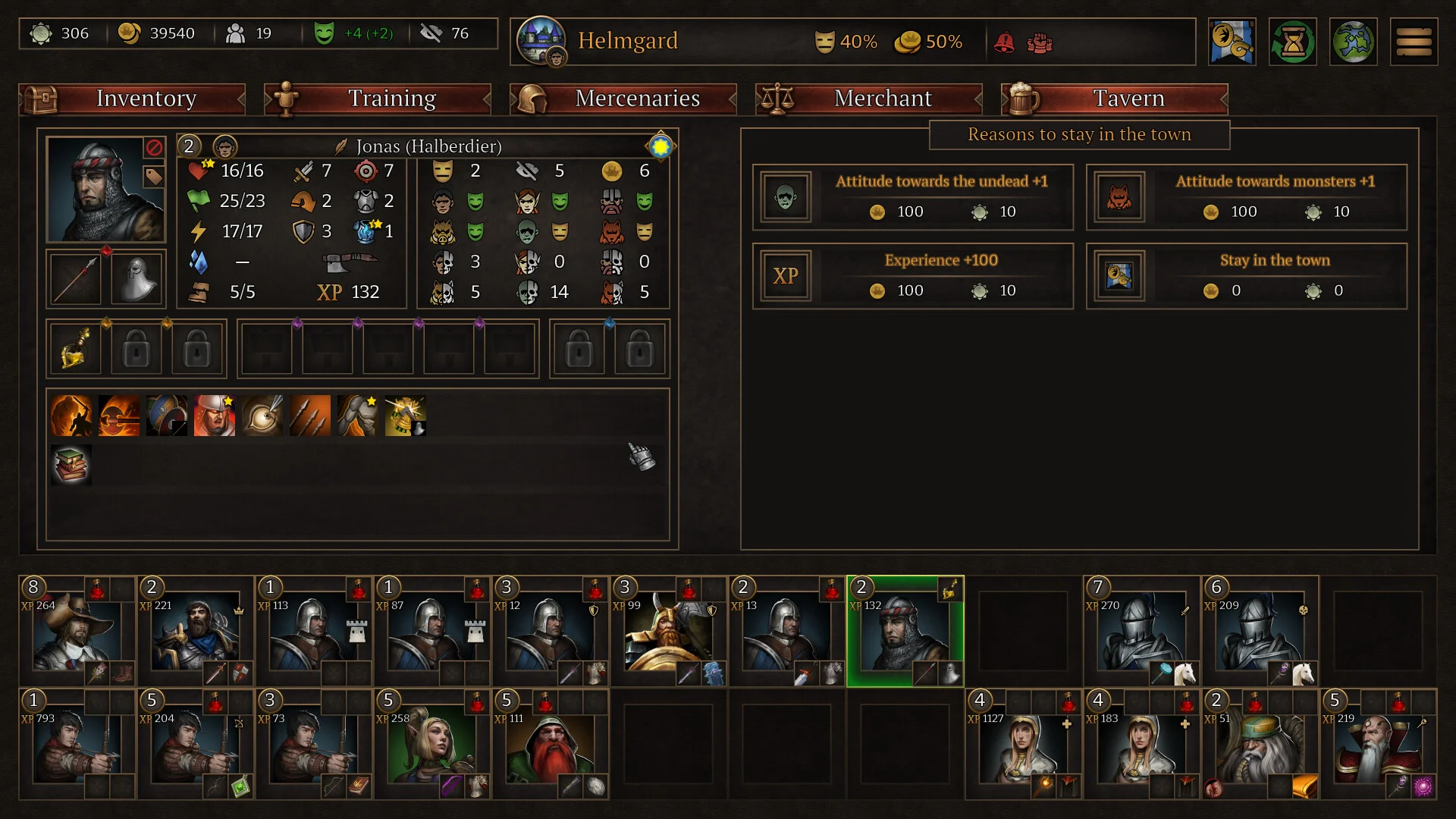
Once you visit multiple settlements and build sufficient standing, you gain access to an impressive roster of mercenaries, spanning from necromancers and mounted knights to orc-like berserkers. Units come with the standard array of attributes and individual stat affinities, but their true distinctiveness lies in their traits. These traits influence many factors—like salary demands or company morale on the road—ensuring no two hires feel identical. I found that balancing these quirks became a compelling puzzle: a morose, hard-hitting warrior who sours the group’s mood might ultimately prove less desirable than a happy-go-lucky recruit who takes longer to train. When deployed onto hex-based battlefields, your warband must contend with terrain, weather, and morale effects while spending Action Points to move, attack, and execute abilities. The turn structure feels refreshingly intuitive, allowing you to take all your moves at once and freely interleave unit activations to pull off satisfying positional strategies.
Layering unique unit traits and positioning them across the hex map becomes your primary focus. For example, warriors gain defense by standing shoulder-to-shoulder, while mounted knights can trample adjacent foes at the end of their turn. Mission variety spans raids, boss rushes, and frustrating escort quests, but settlement sieges steal the show. Besieging the AI triggers some of the game’s brutal highlights: it aggressively targets your vulnerable mages, adapts to your frontline pushes, and unloads catapult fire with precision. Factor in unit facing and weather effects on Accuracy, and it’s evident Veterum plays far more like a wargame than a traditional strategy RPG.
Enjoyment of the combat hinges on how much you relish working the strategic synergies—pooling unit traits, controlling bottlenecks, and managing unit positions and direction. Veterum brutally punishes sloppy play: squishy wizards melt instantly under pressure, and archers become useless in rainy fog. Because defeated units face a high chance of permanent death, you must find joy in the tactical grit of battle rather than the emotional journey of your warband. By the time I reached the campaign’s end, I struggled to remember a single mercenary besides Edward—I burned through too many along the way.
Post-combat experience progression relies strictly on active participation—only units that score kills or provide direct support earn a share. To grow your warband efficiently, you must adopt key tactical habits: feeding low-health enemies to greener recruits and constantly rotating frontline veterans with fresh blood. Earned experience then directly funds improved attributes and specialized combat skills.
Interestingly, a unit’s nominal “level” simply reflects total experience invested rather than providing an automatic stat boost, though it immediately drives up a unit’s salary demands. While I found this a bit unintuitive at first, it heightens the financial tension of managing high-value veterans, making the threat of losing an expensive, heavily-funded warrior feel all the more devastating to your purse.
There’s plenty to do in Veterum; the procedural generation aspect of the scenarios, and the wide range of unit types and open rules for their deployment mean you truly can invoke your ‘army of wizards’ fantasies, presuming you have the coin. The many traits and stat growth permutations multiply this variety tenfold: my own wizard squad were as Peevish as hell, constantly lowering my army’s mood, but they were powerful and blessed with Mana, so I put it with a rogue squad of sorts for many of my battles. On normal, and as intended, it’s a challenging game where every unit hire and combat decision must be considered. It earns its place with the demand and crustiness of its forebears.
Outside of combat, Veterum is bare-bones. Settlements offer brief lore snippets alongside hubs for recruiting mercenaries. Units can remain at a tavern to earn passive experience or grow attitudes, and there are merchants from which to purchase gear. Equipment actively modifies tactical rules—such as burning arrows that allow archers to build bonfires and gain damage bonuses when firing next to them—rather than always boosting raw numbers.
Despite the simple robustness of the systems, the UI doesn’t always provide a smooth experience. Abilities or actions can be difficult to trigger because they don’t provide enough information for how they react on the map. I found examples like the Knight’s Charge, or even picking up and moving siege ladders, to be a headache of wasted action points and lost units or battles. And for such an important tactic, unit facing is fiddly and expensive to get wrong through wasted action points. Again.
Veterum is a battle-hardened, tactically astute member of the mercenary RPG pantheon, but one not attempting to flatter to deceive, or really care much about the scars or wounds they display. It’s all a bit rough and ready, but the underlying thoughts are as sharp as they come. If graphics, sounds, or narrative aren’t your core driving force for guiding a group of fantasy mercs through various tactical scenarios, there is a lot to love here. Otherwise, you might find a different game is more to your sensibilities. For my part, I’ve got a new idea for an Archer Army…