
Much like its vibrant, cyber-grafted cast, Celestial Return stitches together a disparate collage of cyberpunk influences. The game bleeds the gritty attitude of Cyberpunk and Shadowrun through its dialogue and worldbuilding, echoes the internalized psychology and abstract art of Disco Elysium, and still finds room for a slick anime aesthetic in its character design and futurepunk cityscape, as well as a Citizen Sleeper-esque dice resolution system.
While its branching narrative shifts dynamically around the dice outcomes and personality frameworks, the experience ultimately lives or dies by your tolerance for its core thematic dressing and its lack of overall polish. Strip away the love for the neon veneer, and there are times when Celestial Return feels like less than the sum of its cybernetic parts.
As a narrative-first detective RPG, Celestial Return wastes no time establishing the baggage of its protagonist, Howard. You control this grizzled investigator who once belonged to the PID—a specialist squad formed to protect the citizens of Netherveil against “Abstracts,” nebulous, thought-based manifestations that bleed directly from imagination into reality onto the city streets. Following a brief prologue exploring Howard’s past, a routine investigation into a triple homicide rapidly spirals into a surreal, metaphysical head-trip.
Yet, despite this bizarre backdrop, the detective tropes feel instantly familiar. Howard rigidly embodies the cynical, world-weary lawman who has seen too much and felt too little. Perhaps I’ve been spoiled by Disco Elysium, Zero Parades, or even Anachronox, but Celestial Return‘s opening acts ultimately asks you to sift through a case file you may have read a hundred times before, lit by the flickering neon of a cliché.
The prose is undeniably sharp, though it frequently veers into self-indulgent verbosity. By lifting Disco Elysium’s internal monologue mechanic—here divided into Intelligence, Anger-Management, Foolishness, Perception and Virtue—the writing in Celestial Return showcases a decent stylistic range, but it simultaneously traps the game in a shadow it can’t quite escape. Are we officially entering the era of the “Disco-like”?
The trouble is that Celestial Return lacks its inspiration’s mechanical transparency. Outside of occasionally locked dialogue options, the cause and effect of these personality lenses remain frustratingly opaque. Furthermore, the narrative leans so heavily on bloated, noun-heavy descriptions that crucial information regularly suffocates under the prose. You will frequently find yourself staring at a quest notification, desperately trying to reconcile a dry log entry with whatever absurd fever dream you just witnessed—like a lengthy, high-minded philosophical debate with a talking rose flower. I kid you not.
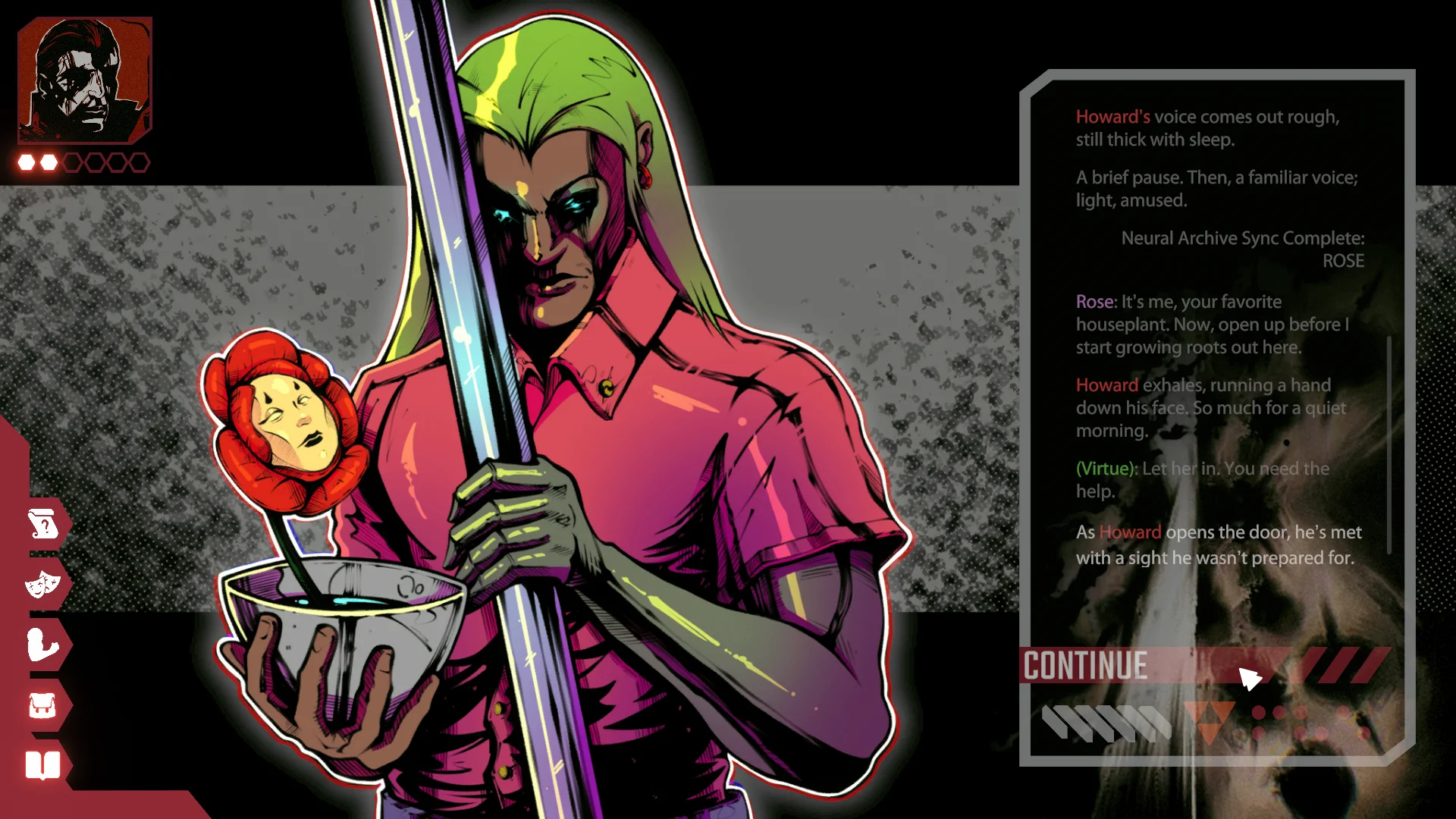
Despite these flaws, Celestial Return maintains a fiercely earnest tone. The developers clearly want to say something profound about identity and self-determination under the thumb of techno-authoritarianism. In utilizing the Abstracts, they find a genuinely fresh lens through which to examine humanity’s slouch toward cybernetic hybridity. Yet, as noted from the outset, your mileage depends entirely on your appetite for the genre. Perhaps that stagnation is inevitable. Decades after Philip K. Dick et al laid the groundwork, our collective anxieties regarding identity, autonomy, and algorithmic control have ceased to be speculative fiction. They have arguably become our reality, and Celestial Return (and other such works) perhaps now suffer more because of how this arc of human progress has shortened.
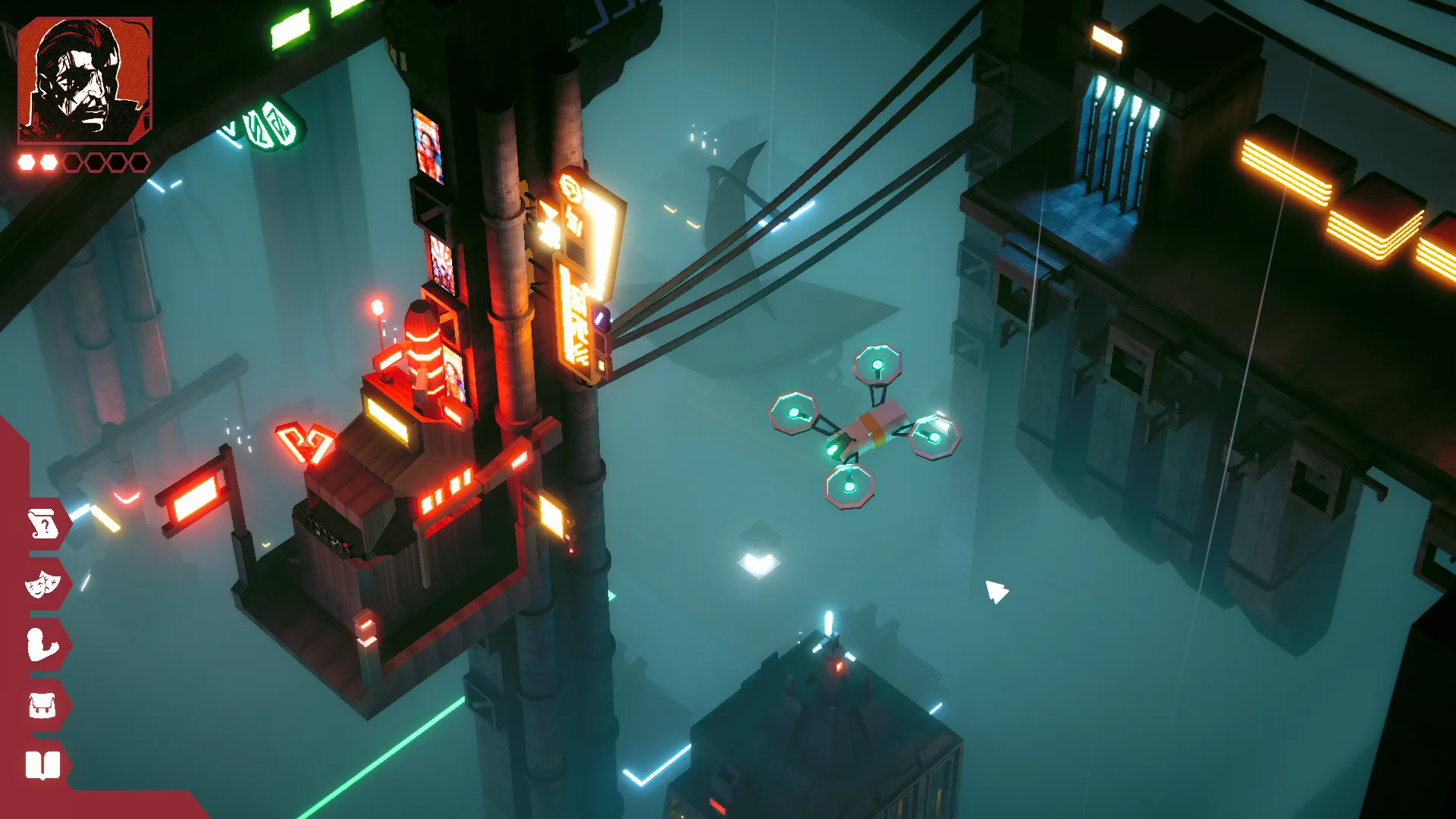
Graphically, the city of Netherveil amounts to a simple animated diorama. Howard navigates this map where emerging hotspots trigger self-contained scenes—a pretty set of neon buildings that serve mostly as a delivery system for the narrative. It is within these encounter scenes that the game’s rich anime aesthetic and unsettling character design truly feast. The artistic direction here is immaculate. Utilizing everything from stark, monochrome photography and film clips to Escher-like architectural illustrations, the visual direction embraces a minimalist look while keeping a sense of ambient unease and cosmic weirdness at the absolute forefront.
As a marriage of cyberpunk grime and psychological horror, Celestial Return utterly nails the presentation of these mostly static vignettes. Even the bold, oversized title cards that herald each new chapter work to anchor you within its grander ideas. Ultimately, I never tired of seeing exactly how the developers would stage their next bizarre tableau and how it sharpened the tension inherent in the game and in Howard throughout.
The music score is driven by three key tracks that bookend each chapter and straddle the gamut of post-synth retro, heavier techno, and even a spread of death metal. The music videos accompanying these tracks bring together some of the images used during Howard’s exploration, and they work well to bring everything together in an original way. Outside of this, sparse alerts for different personality choices and a very small but effective use of voice-over complete the auditory catalogue.
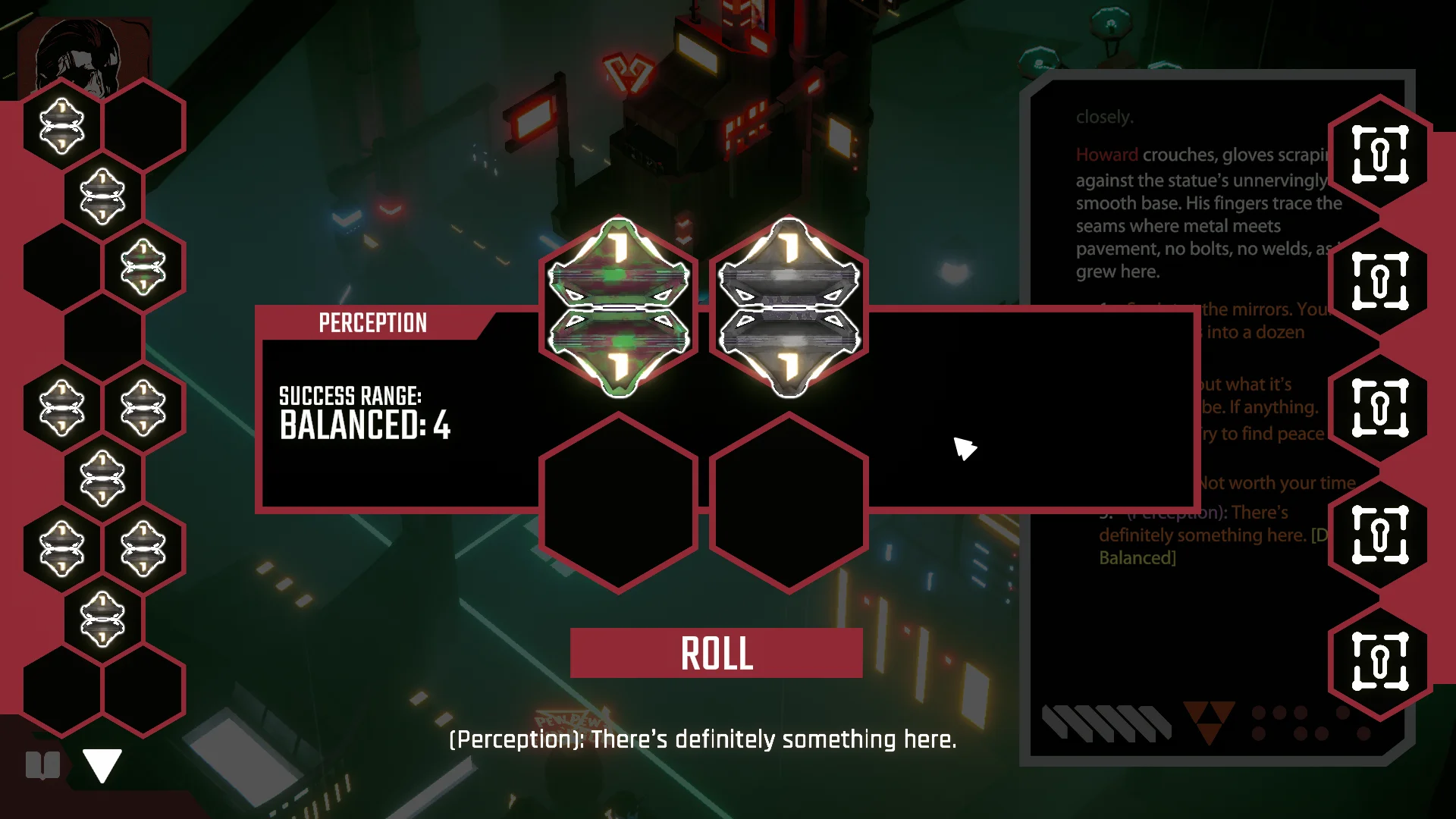
Once the narrative gains momentum, Celestial Return introduces personality-driven skill checks. While most of these options simply let Howard explore a specific train of thought, others remain locked behind previous decisions or demand a direct dice roll. Howard begins with a pool of dice that act as a bizarre meta-currency, pulling double duty as both his health and his wealth. While you can collect or purchase more dice as you progress, not all dice are created equal. Some dice inject negative modifiers into your rolls—representing Howard’s unchecked anger, for instance—while others grant positive bonuses, and a rare few guarantee an automatic pass. Regardless of the type used, only four dice can be rolled at any given check.
This is where the high-stakes reality of treating dice as health—or “oxygen,” as the game frames it—crystallizes. Because checks permanently consume your selected dice, risk management becomes paramount. Run out of dice entirely, and Celestial Return effectively soft-locks, leaving you with nothing but a prompt to roll better next time.
Navigating this system demands a sharp learning curve; I quickly learned to actively hold back on non-essential checks, hoarding my negative dice to act as cheap fodder to barter with NPCs or secure key items. Some items grant either permanent passive bonuses to specific personality traits or crucial, one-time boosts. Furthermore, as Howard accumulates experience from his investigation, he unlocks deeper personality insights and hidden revelations that grant permanent bonuses, serving to specialise his focus and make specific tests easier.
While the loop becomes second nature after a few conversations, several design hurdles trip up the experience. Inventory management is a finicky chore; scrolling through dozens of dice is a tedious process, and a lack of organization for passive items quickly turns your gear screen into an exhaustive click-fest.
More frustrating is the lack of foresight. Beyond a bare-bones “recommended” dice count for any given dialogue check, the game refuses to telegraph what lies ahead. You never know if throwing your weight behind a massive roll will immediately leave you bankrupt for a gauntlet of subsequent checks. Consequently, in a genre where failure should ideally lead to interesting narrative branches, Celestial Return invites save-scumming simply to keep the game playable. Sometimes, you reload not because you want to see a different path, but because you literally do not have the dice currency to proceed.
All this interplay of personality-locked dialogues, multiple map points, and branching dialogues does mean there’s a healthy number of bugs and non-sequitur moments in the current build of Celestial Return, though the dev seems responsive to reported issues. There are soft-locks on progression when map markers disappear, or won’t interact, and the save/load process does not always register properly. Alongside the inventory issues, there’s a lack of polish to be accepted.
If you can make it through these frustrations, Celestial Return does not overstay its welcome for its bargain price. The three books comprising Howard’s story top out around half a dozen hours, depending on reading speed and attention to detail. Clearly, there are alternative paths and points of view to consider on a replay, and discovering all the secret insights and the vast range of items would take some forensic trial and error.
Celestial Return is an enjoyable narrative RPG, where the simple encounter systems work well enough and the cosmic horror feel to its main adversaries displays enough of a point of difference to make its cyberpunk city worth visiting over so many other similar locations. But the familiarity of the main character’s conceit, issues with clunky inventory and verbosity, as well as buggy cohesion, add some acid to the sweet, hard rain slicking the dark streets. It’s for you to decide whether there’re enough viable parts here for you to assemble into a relatively enjoyable whole, or whether the essence cost in time and enjoyment is just too great. Your move, choomba.